Colombian Currency, Avoiding Counterfeits and Exchanging Money
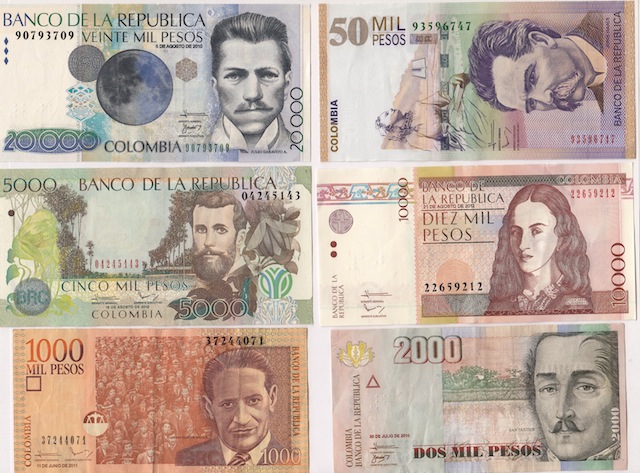
Colombia’s currency system uses the Colombia peso (COP). It comes in six different note denominations:
- 50,000-peso note
- 20,000-peso note
- 10,000-peso note
- 5,000-peso note
- 2,000-peso note
- 1,000-peso note
Colombia also uses five different coins: 1,000 pesos, 500 pesos, 200 pesos, 100 pesos and 50 pesos. There are two versions of the coins currently in circulation.
Photos of the Colombian currency notes and coins in circulation can be found on the Banco de la República website.
A proposal was recently submitted by Finance Minister Mauricio Cardenas to cut three zeros from Colombia’s currency system. This would make currency conversions easier. Also with so many zeros currently it is more likely errors are being made.
When figures go beyond 1 billion pesos it can get confusing for people unfamiliar with Spanish. Billions are expressed as thousands of millions and trillions are called “billones.”
The exchange rate fluctuates daily but the dollar has been strong recently. A recent exchange rate was 2,408 pesos per U.S. dollar. So a 10,000-peso taxi ride would be $4.15. Under the proposed change this would become a 10-peso taxi ride.
However, a government initiative to rebase the Colombian currency with fewer zeros failed four years ago on concerns that expenses to print new bills, change accounting and switch prices would outweigh the benefits.
Avoiding Counterfeits
Don’t ever change your money on the street in Colombia, as counterfeit money is common. The best way to get the local currency is through an ATM.
I have received three counterfeit bills over the eight years I have been traveling to Colombia, including living over three years in Medellín.
Two of the counterfeits I received were 20,000 peso notes given in change, which I luckily caught both times, as the counterfeits weren’t that good. So I exchanged the fakes for real bills. This happened once in a bar in Cartagena and once in a small shop in Medellín.
The other was a counterfeit 50,000-peso note that I received from either an ATM or money exchange place in Medellín. I used both one day so I am not sure from which I received the counterfeit. I normally don’t check the bills received from an ATM machine or money exchange place, so I didn’t catch this until later.
The most common counterfeit notes in Colombia are the 20,000 peso and 50,000 peso notes. There have also been some counterfeit 1,000 peso coins – the new version of the coins. A guide to the new Colombian coins (in Spanish) is found here.
One of the easiest ways to check to see if a Colombian bill is real is to rub it against a piece of paper. If some ink rubs off, it likely isn’t a counterfeit. I see clerks in stores do this frequently.
You can also tell by the feel of the bills. Genuine bills have some texture to them and the three counterfeits I encountered didn’t have texture.
On a genuine 50,000 peso note, if you look at the large 50 on the front of the bill at angles it changes color. On the counterfeit I received it didn’t change color.
On a genuine 20,000 peso note, if you look at the hexagon on the front of the bill at angles it changes color. On the two counterfeits I received the hexagon didn’t change color.
On a genuine 50,000 peso note there is a “50 MIL” watermark under “COLOMBIA” on the front of the bill. On the counterfeit I received there was an attempt to copy the watermark but it didn’t look the same.
Colombian bills use a number of security features. A complete list of the security features of Colombian bills in circulation can be found on the Banco de la República website (in Spanish).
Until recently, Colombia was the top producer of counterfeit U.S. bills but that distinction now reportedly goes to Peru. So also be sure to check any U.S. bills you receive while in Colombia.
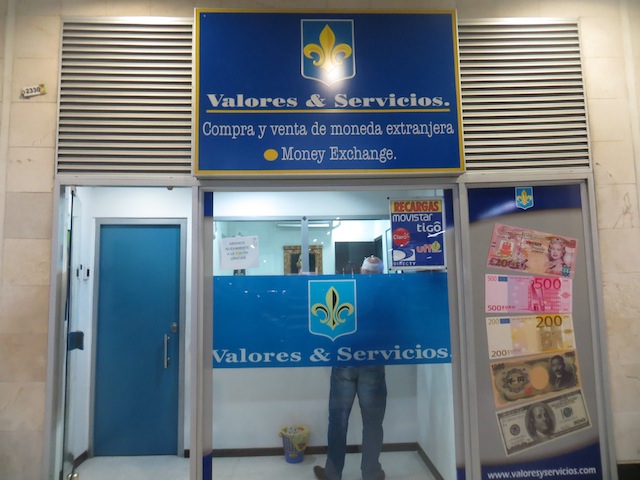
Exchanging Money
You can use ATMs, banks or money exchange places (casas de cambio) to get Colombian currency.
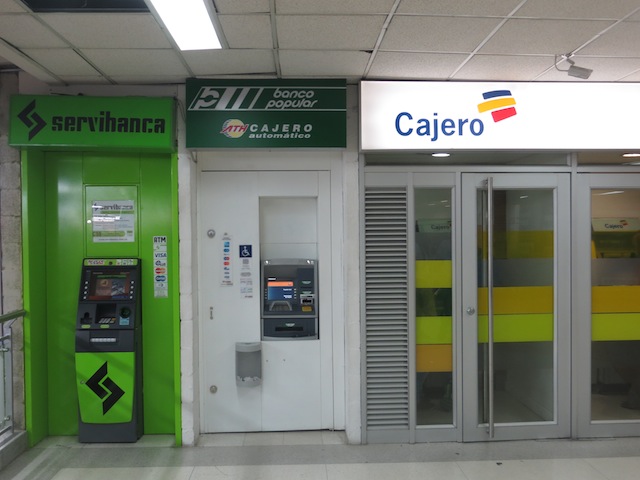
With ATMs you will usually get the best exchange rate. ATMs are plentiful in Colombia with several normally found in each mall. They are also found in many locations on the streets.
However, be careful of using ATMs located on the street; it is safer to use ATMs inside a mall.
At Medellín’s José María Córdova International Airport you will find ATM machines on the level with the airline check-in desks.
For exchanging currency, casas de cambio sometimes offer slightly better rates than banks and have more flexible hours plus provide quicker service. You can find casas de cambio in many of the malls in Colombia.
You will need a passport or cédula (Colombian ID) to exchange money in a casa de cambio or bank in Colombia.
A few times in the past I have seen casas de cambio with exchange rates slightly better than the rate found on xe.com. But this hasn’t been the case recently with the strong dollar.