2017 Update: Exchanging Money and Avoiding Counterfeits in Colombia
You can use ATMs, banks or money exchange places (casas de cambio) to get Colombian currency when in Colombia. These are the most common methods used for exchanging money by expats visiting Colombia.
With ATMs you will usually get the best exchange rate that is close to the official exchange rate. ATMs are plentiful in Colombia with several normally found in each mall. They are also found in many locations on the streets.
However, be careful of using ATMs located on the street; it is safer to use ATMs inside a mall. At Medellín’s José María Córdova International Airport you will find one ATM machine on the lower arrival level.
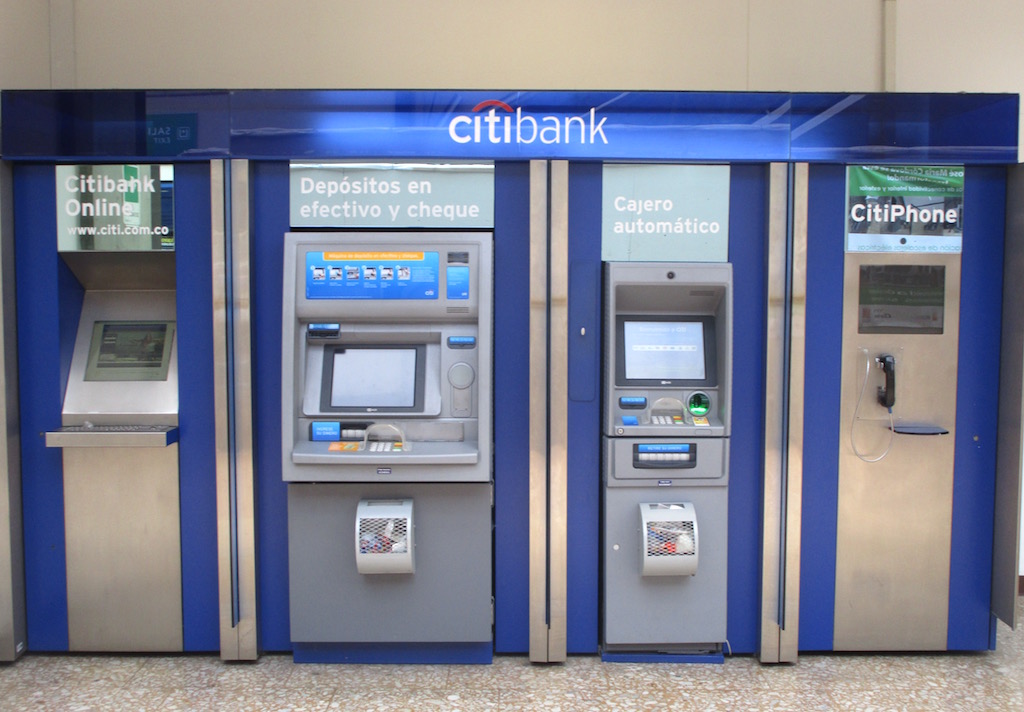
There are many more ATM machines on the upper level with the airline check-in desks. The above photo is a Citibank ATM machine at Medellín’s international airport on the upper level with the check-in desks.
ATMs will typically have a limit of how much you can withdraw per transaction. For example, ServiBanca’s limit is normally 780,000 pesos and Bancolombia’s limit is normally 600,000 pesos.
Also make sure to provide a travel notification to your bank before traveling to Colombia. If not, your ATM card will likely not work in Colombia. In addition, look for banks that don’t charge foreign transaction fees and some don’t charge ATM fees.
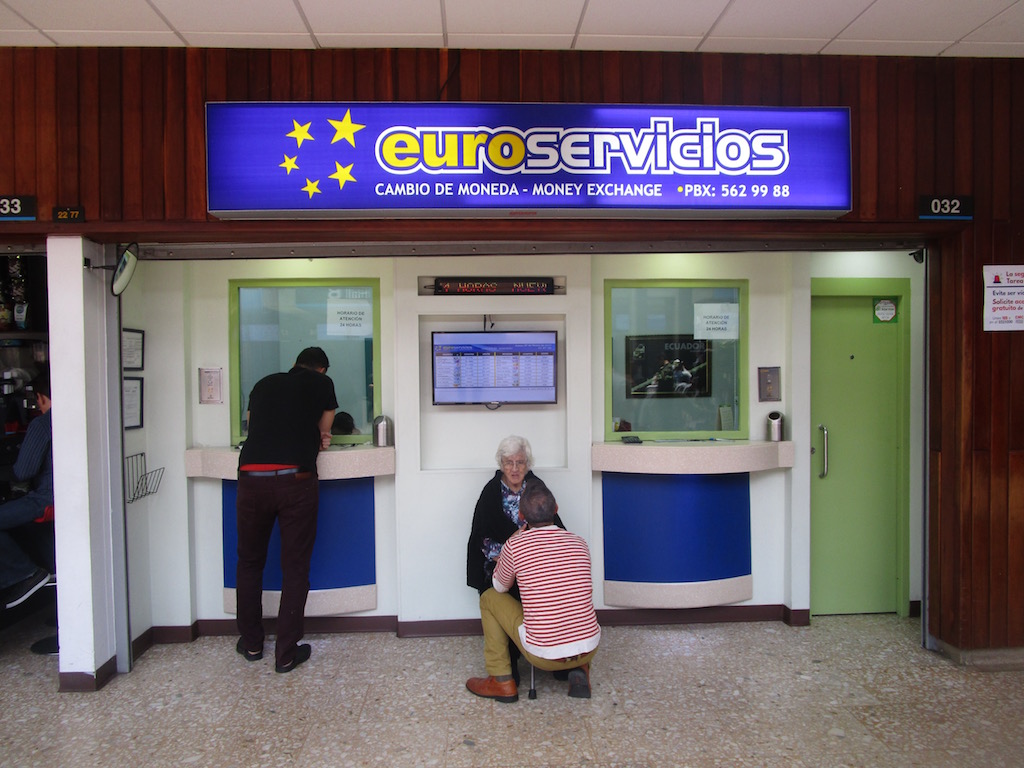
For exchanging money, you can use casas de cambio (money exchange houses) or banks. The banks will sometimes have a somewhat better exchange rate. You can find money exchange places in many of the malls in Colombia and they typically are open more hours than the banks.
I personally wouldn’t recommend using a money exchange place or a bank as you’ll normally receive a worse exchange rate compared to an ATM. For example, at the Medellín airport yesterday I saw a money exchange with an exchange rate of 2,775 pesos per U.S. dollar. At the same time the exchange rate on xe.com was 2,912 pesos per USD. So, this was nearly a 5 percent charge.
Charges at money exchange places in Colombia tend to range from 4 to 10 percent. You will also need a passport or cédula (Colombian ID) for exchanging money in a casa de cambio or bank in Colombia.
Other Exchanging Money Options
A new mobile app is another option for exchanging money. Zeepod is a new app, which enables exchanging money directly with other people in person. This permits you to avoid the currency exchange places (casa de cambios) with their typically poor exchange rates.
A friend exchanged $700 USD to pesos using this Zeepod app recently and he got an exchange rate of 2,900 COP when the rate listed on xe.com was 2,913 COP. He met the person at Oviedo mall in El Poblado.
Once you are established in Colombia with a bank account you also have the option for doing wire transfers to your bank account in Colombia. I have a bank account with Colpatria and have done several wire transfers with exchange rates very near to the official rate.
Currency in Colombia
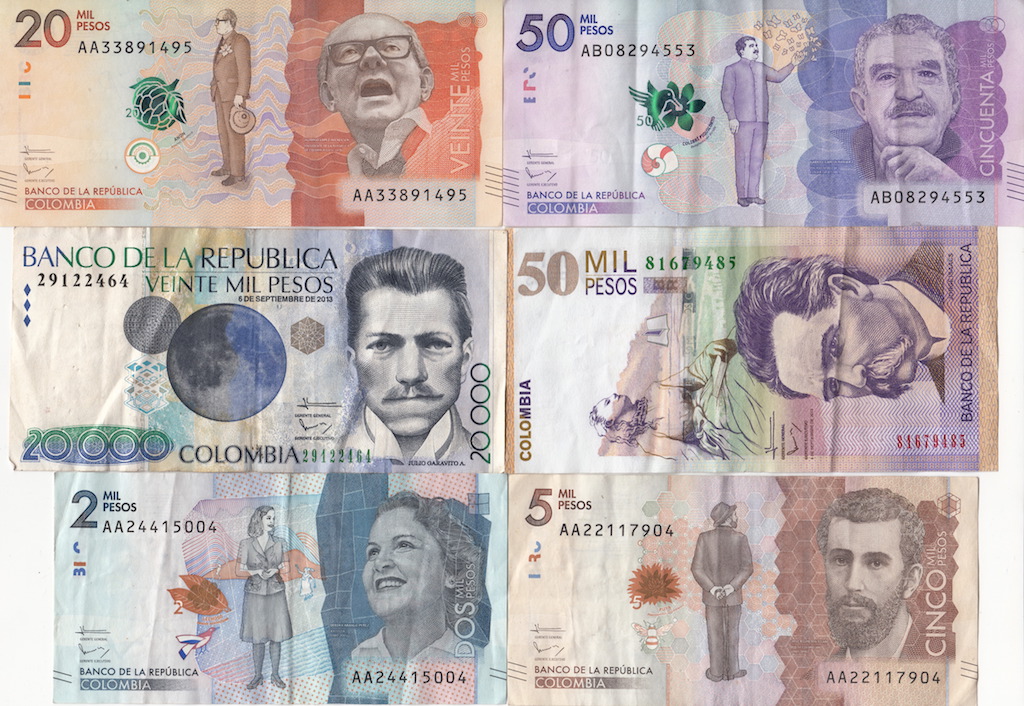
Colombia’s currency system uses the Colombia peso (COP). It now comes in seven different note denominations:
- 100,000-peso note
- 50,000-peso note
- 20,000-peso note
- 10,000-peso note
- 5,000-peso note
- 2,000-peso note
- 1,000-peso note
In 2016, Colombia introduced new notes. The 100,000-peoso note is new and didn’t exist before. You will also find two versions of 50,000-peso, 20,000-peso, 10,000-peso, 5,000-peso and 2,000-peso notes in circulation.
Colombia also uses five different coins: 1,000 pesos, 500 pesos, 200 pesos, 100 pesos and 50 pesos. There are two versions of the coins currently in circulation.
Photos of the Colombian currency notes and coins in circulation can be found on the Banco de la República website.
A proposal was submitted by Finance Minister Mauricio Cardenas to cut three zeros from Colombia’s currency system. This would make currency conversions easier. Also with so many zeros currently it is more likely errors are being made.
When figures go beyond 1 billion pesos it can get confusing for people unfamiliar with Spanish. Billions are expressed as thousands of millions and trillions are called “billones.”
The exchange rate fluctuates daily but the dollar has been strong recently. A recent exchange rate was 2,912 pesos per U.S. dollar. So a 10,000-peso taxi ride would be $3.43. Under the proposed change this would become a 10-peso taxi ride.
However, a government initiative to rebase the Colombian currency with fewer zeros failed over five years ago on concerns that expenses to print new bills, change accounting and switch prices would outweigh the benefits. But the newest notes in Colombia are without the last three zeros. For example, the new 50,000-peso note says 50 mil pesos.
Counterfeits
Don’t ever change your money on the street in Colombia, as counterfeit money is common. The best way to get the local currency is through an ATM.
I have received three counterfeit bills over the ten years I have been traveling to Colombia, including living over six years in Medellín.
Two of the counterfeits I received were 20,000 peso notes given in change, which I luckily caught both times, as the counterfeits weren’t that good. So I exchanged the fakes for real bills. This happened once in a bar in Cartagena and once in a small shop in Medellín.
The other was a counterfeit 50,000-peso note that I received from either an ATM or money exchange place in Medellín. I used both one day so I am not sure from which I received the counterfeit. I normally don’t check the bills received from an ATM machine or money exchange place, so I didn’t catch this until later.
The most common counterfeit notes in Colombia are the 20,000-peso and 50,000-peso notes plus the new 100,000-peso note. There have also been some counterfeit 1,000 peso coins – the new version of the coins. A guide to the new Colombian coins (in Spanish) is found here.
Until recently, Colombia was the top producer of counterfeit U.S. bills but that distinction now reportedly goes to Peru. So, also be sure to check any U.S. bills you receive while in Colombia.
Guide to Avoiding Counterfeits
One of the easiest ways to check to see if a Colombian bill is real is to rub it against a piece of paper. If some ink rubs off, it likely isn’t a counterfeit. I see clerks in stores do this sometimes.
You can also tell by the feel of the bills. Genuine bills have some texture to them and the three counterfeits I encountered didn’t have texture. Colombian bills use a number of security features.
For example, on a genuine old 50,000-peso note, if you look at the large 50 on the front of the bill at angles it changes color. On the counterfeit I received it didn’t change color. On a genuine old 50,000-peso note there is a “50 MIL” watermark under “COLOMBIA” on the front of the bill. On the counterfeit I received there was an attempt to copy the watermark but it didn’t look the same.
On a genuine new 50,000-peso note there is a flower on the front that changes color when looked at from different angles. On the new 100,000-peso note there is also a flower on the front that changes color when looked at from different angles.
On a genuine old 20,000-peso note, if you look at the hexagon on the front of the bill at angles it changes color. On the two counterfeits I received the hexagon didn’t change color.
A complete list of the security features of the old Colombian notes in circulation can be found on the Banco de la República website (in Spanish). In addition, this website also includes security features of the new notes here.
The Bottom Line: Exchanging Money
The best ways to exchange money and get a rate as close as possible to the official exchange rate are to use ATMs or the new Zeepod mobile app. And if you have a Colombian bank account, you can use wire transfers. If you use a casa de cambio (money exchange) or bank branch you’ll normally get a worse exchange rate than the other methods.
Also, be careful of the bills you receive as counterfeits can occasionally be found in Colombia, particularly the higher denomination notes. Not everyone is familiar with the security features of the new Colombian currency so reportedly they are starting to be counterfeited as well as the old notes.