Filing Colombia Income Taxes (2016 Update)
Tax time for filing Colombia income taxes for 2015 is fast approaching. In Colombia personal income tax returns are filed later in the year than in the U.S.
In Colombia, the dates to file personal tax returns for the prior year normally start in August. Personal income taxes in Colombia are known as “renta personas naturales.”
DIAN is the agency in Colombia responsible for collecting income taxes. DIAN performs similar functions as the IRS does in the U.S.
Note the following is based on my understanding of Colombian income taxes based on my experience in filing taxes in Colombia. It is also based on my discussions with my Colombian tax accountant.
But keep in mind I am not a tax expert. We strongly recommend consulting a tax expert. Also beware there is a lot of inaccurate and old information about Colombian income taxes out on the Internet.
Note the official exchange rate on December 31, 2015 was 3,149.47 pesos to the US dollar, which is used in this article. UVT for 2015 is 28,279 pesos.
Filing Colombia Income Taxes – Requirements
An individual is considered a Colombian resident for tax purposes if he or she stays in Colombia for more than 183 days during a year. This is whether or not the stay was continuous during the year.
Also this year is any 365 day period so it is not necessarily a calendar year, it can straddle two years. For example, 100 days in the last six months of year one and then 84 days in the first five months of year two (the next year) would make you a tax resident in year two.
If you are considered a Colombian resident for tax purposes, you are not required to file income taxes in Colombia if all of the following requirements (for 2015) are met:
- Gross income in 2015 is less than 1,400 UVT, which is 39,591,000 pesos ($12,751 USD at official exchange rate at end of 2015)
- Gross equity (net worth) on the last day of 2015 does not exceed 4,500 UVT, which is 127,256,000 pesos ($40,405 USD).
- Credit card consumption in 2015 does not exceed 2,800 UVT, which is 79,181,000 pesos ($25,141 USD).
- Total value of purchases and consumption in 2015 does not exceed 2,800 UVT, which is 79,181,000 pesos ($25,141 USD).
- Total value of accumulated bank savings, deposits or financial investments held at the end of 2014 does not exceed 4,500 UVT, which is 127,256,000 pesos ($40,405 USD)
If you are a Colombian resident for tax purposes and exceed any one of these amounts, you are technically required to file income taxes in Colombia.
Note that Colombia taxes worldwide income, just like the United State does. If your worldwide income is $12,751 or over and you are a tax resident of Colombia you are technically required to file income taxes in Colombia.
That is a pretty low-income barrier for needing to file taxes. There is a penalty for not filing income taxes in Colombia even if you don’t owe any taxes.
The minimum penalty for not filing if you are required to in Colombia is reportedly 10 UVT or 282,790 pesos.
If you didn’t file and owed taxes, the normal penalty is at least 5% of what was owed but reportedly can go as high as 200%. Plus you add interest on unpaid amounts that runs about 30% per year. DIAN can reportedly audit you for up to two years.
When and How to File Colombia Income Taxes?
Your Colombia income taxes filing date depends on the last two digits your Colombia tax ID number, which is known as a Número de Identificacíon de Tributaria (NIT).
The filing dates in Colombia for income taxes for individuals for the 2015 tax year start in 2016 on August 9 and run until October 19.
The complete schedule of filing dates for 2015 Colombia personal income tax returns during 2016 can be found on the DIAN website here.
Once your Colombia tax return is completed on a Form 210, you simply take it to any bank and pay the tax due or get the form stamped as processed without payment if you don’t owe any taxes.
How to Get a NIT
To get a NIT, you must go to a DIAN office to request one. The NIT is found on a RUT (Registro Único Tributario) form that will be given to you when you go to a DIAN office.
In Medellín, to get a NIT you just need to go to the DIAN office in the Alpujarra administrative complex.
DIAN’s office in Alpujarra is located in the basement of one of the buildings. You can ask any of the security guards which building has the DIAN office.
When you enter the DIAN office at the entrance just say you need a NIT for the first time.
You will need to bring your original ID (cedula or passport) and a copy of your ID (front and back of cedula or data page of passport).
They will direct you to a reception desk that will give you a number to wait your turn. Watch the monitors for your number.
When your number is called you go to a desk and they will ask you for the copy of your ID. They will also ask for your address, your phone number and for an activity code. The activity code is the type of work you do. A list of activity codes (in Spanish) can be found here.
The entire process in the DIAN office in Medellín took me less than 20 minutes when I did this last year. I understand the DIAN office is often less busy in the mornings.
Colombia Income Tax Rates
Colombia has progressive income tax rates like in the U.S. that max out in Colombia at 33 percent. The following is the tax table for 2015 income taxes in Colombia:
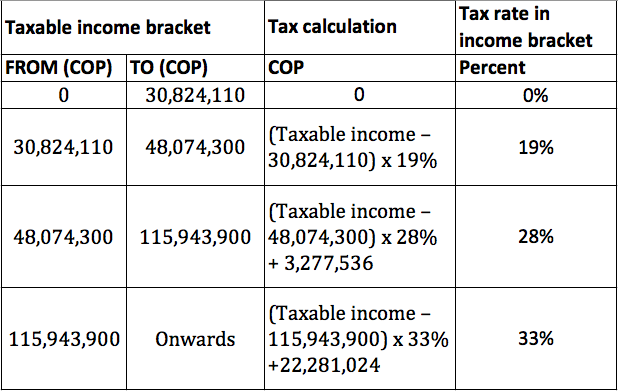
Note that there isn’t any tax break in the tax rate schedule for Colombia for your marital status (being married) or for having children. However, it is possible to have a limited deduction from your income in Colombia for dependents.
Calculating Colombia Income Taxes
In Colombia income taxes are calculated starting with your gross income. According to my accountant something new for 2015 is that interest from savings is exempt from income taxes.
While I am still many years from retirement age I asked my accountant about U.S. Social Security. She said that foreign pensions/retirements are taxed in Colombia according to a ruling from DIAN. However Colombian pensions are exempt from Colombia income taxes (up to a limit).
To calculate Colombia income taxes you start with gross income and deduct a variety of deductions including:
- Expenses related to receiving your income – this could include such items as travel expenses and home office expenses
- Mortgage interest for the taxpayer’s dwelling – limited to 1,200 UVT, which is 33,934,800 pesos ($10,775 USD)
- Colombia health insurance – Payments towards medical insurance in Colombia that is limited to 192 UVT, which is 5,429,568 pesos ($1,724 USD)
- Economic support of dependents – limited to 384 UVT, which is 10,859,136 pesos ($3,448 USD)
- Pension/retirement savings contributions – limited to 3,800 UVT, which is 107,460,200 pesos ($34,120 USD)
- 25 percent of your labor salary (gross income minus costs and deductions) – which is exempt from taxes up to a limit of 2,880 UVT, which is 81,443,520 pesos ($25,859 USD)
The result after subtracting deductions is your taxable income.
You then calculate Colombian income taxes due for your taxable income using the Colombia income tax table (see above).
After calculating Colombian income taxes due you can subtract income taxes paid in another country.
For example, I have a job in the U.S. but work remotely from Colombia. I pay income taxes in the U.S. on my income since the U.S. taxes citizens wherever they are in the world.
I also file income taxes in Colombia. But I didn’t have to pay any income taxes in Colombia last year for 2014 since I paid more income taxes in the U.S. for 2014 than my calculated Colombian income taxes due. So after subtraction my net income taxes due in Colombia last year was zero.
What Exchange Rate to Use
For end-of-year bank statements, credit card statements and account statements in another currency used to show net worth you should use the the official exchange rate on December 31, 2015, which was 3,149.47 pesos to the US dollar.
For a salary you receive and expense payments you make over the year in another currency you have two option for the exchange rate to use. You can the use official exchange rate on December 31, 2015 (3,149.47) for the annual total of each item. Or you can use the official exchange rate on the day when you receive or pay each item.
For example to convert an annual salary to pesos to be used to calculate Colombian taxes you could just use the December 31, 2015 exchange rate for the total.
Or you could use the official exchange rate on the date of each salary payment received during the year multiplied by each individual salary receipt. If you were paid twice a month you would have to make 24 calculations with 24 different exchange rates. You would also need records for each salary payment received such as pay-stubs.
Here’s a list of official exchange rates in Colombia during the year 2015. On January 1, 2015 the exchange rate was 2,392.46 pesos to the USD. By year-end this had increased to 3,149.47.
For 2015, if you received a monthly salary in USD it would covert to fewer pesos for Colombia tax purpose if you calculate using the exchange rate on the date of each salary payment during the year.
Possible Marriage Tax Penalty in Colombia
My tax situation changed in 2015. I got married in Colombia last year. The Colombian peso exchange rate also dramatically changed during the year from the end of 2014 to the end of 2015.
The change in the exchange rate during the year basically pushed more of my U.S. income in terms of pesos into higher tax brackets in Colombia.
The end result of these two changes is this year is I will have to pay some income taxes in Colombia for the first time. But my income taxes in Colombia for 2015 are less than 10% of my income taxes in the U.S.
This is partly because of the higher exchange rates last year, especially toward the end of the year. In addition I paid fewer taxes in the U.S. for last year due to now being married. So I have fewer U.S. taxes to subtract from my Colombian taxes due.
There being no such thing as married filing jointly in Colombia, everyone files separately.
Because of this if one spouse earns most of the income there is possibility of a “marriage tax penalty” in Colombia in comparison to the U.S., which has separate tax brackets for married couples. This depends on income levels and the income split between spouses.
In the U.S. there can be a marriage tax bonus (paying less taxes) when two individuals with disparate incomes marry due to the wider tax brackets for married couples.
The Bottom Line
If you think you need to file a Colombian income tax return, you should talk to a tax expert. A tax expert can help you navigate all of the Colombian regulations, determine what you can deduct, and help you file.
I use a bilingual accountant to file my Colombian income tax returns. She has many expat clients and her name, title and contact information are:
Paula Cruz, Colombian Public Accountant, email: paulaandreacruz@gmail.com, Skype: cliping21
My cost this year for filing taxes in Colombia using her services was 350,000 pesos ($120).
If you work remotely in Colombia with a job in the U.S. as I do, it is possible that you may not have to pay any income taxes in Colombia as I did last year.
Or you may have to pay some income taxes in Colombia, depending on your personal situation. The bottom line is that moving to Colombia can be tax neutral for some but not all. Moving to Colombia had been tax neutral for me until this year.