Is Medellín at Risk for a Major Earthquake?
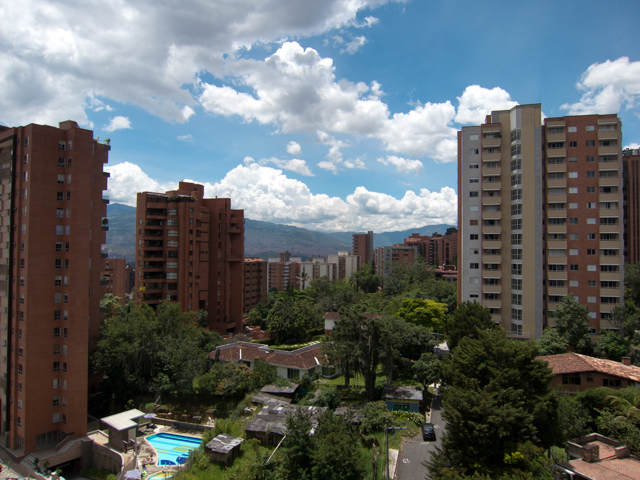
No place in the world is earthquake safe. And this includes Medellín.
As a now-retired professional geologist, formerly with Chevron, educator and science writer for the National Science Foundation, it’s often been my role to prepare the public for seismic events especially coming from San Francisco as I do.
Earthquake safety requires above all being psychologically prepared for when the earth gets ancy, bounces, shakes and rock-and-rolls.
What’s going on when the earthquake causes landslides and the whole region moves downhill? Or when the ground underneath your building liquefies and everything moves and slumps and gurgles?
What’s happening and what can we expect in Medellin? When busted gas and electric lines cause fires and busted water mains keep the fires from being well-fought by the bomberos, are we prepared with a more objective, knowledge-based mindset than we might have been before?
Make no mistake; earthquakes are frightening events. But it’s important to remain as calm as possible so that you can make the proper decisions looking after those persons and things that are precious to you.
Psychological preparedness means that you understand what the percentages are in Medellín for damaging earthquakes, that you understand what causes earthquakes and what to expect from the quake and its aftershocks.
Surprisingly, Medellín is not a high risk candidate for earthquakes or their damage. So folks here can rest pretty sure that a major disaster would be a very rare thing.
As part of the Andean system which is part of the “Circum-Pacific Ring of Fire” one would expect the Aburra Valley to have a long and disaster-filled seismic history.
Indeed the valley is bounded by two north-south running strike-slip horizontal motion faults, the Romerol System, which is similar to the famous San Andreas fault in California.
But the system on the northern part of the Romerol Fault has not created any quakes larger than M=5 energy, and is therefore nowhere near as dangerous as the San Andreas which can easily generate much stronger M=7 or 8 magnitude earthquakes.
A quake of M=5 is about one hundredth as energetic as a M=7 would be. It was an M=5 equivalent which was felt here last year which originated in eastern Colombia and caused some swaying of the taller buildings but no damage here.
The city of Medellín is sited on a giant block of andesite, a batholith, a very solid gigantic and deep-rooted chunk of igneous rock, hard like granite and resistant to seismic motion.
Other deep basement rocks are schists (strong metamorphic rocks) along the faults and irregularly shaped stocks of eclogite which form the hills in the center of the valley, like Cerro Volador and Cerro Nutibara.
Each of these rocks are what we call “competent,” that is they stay together, don’t fracture easily, don’t deform easily, and if earthquake waves cross them, they move as a block and do not continue to wiggle and shake like other rock types and soils may.
That resistance to continuing shaking is what makes the valley safer probably, NOTE – probably- than many other places in Colombia. There is no certainty that the Aburra Valley will not have major damaging seismic events, but the odds are strongly against it.
It’s just good sense to be prepared with emergency medical supplies and food and water. It is just good sense to know CPR and first aid.
However, hollow core non-reinforced masonry brick construction which we see throughout the valley and up the slopes does not do well in seismic zones as a rule because those buildings are brittle. They do not sway and give, and therefore cannot withstand severe shaking.
In modern high rises you might experience frightening swaying, but in most cases, that’s a good thing. The swaying is the building’s natural vibratory response to the seismic waves and allows the building to dissipate the energy relatively harmlessly.
The earthquakes which we have felt over the years in Medellín have their epicenters across Colombia, and the waves propagate through our valley with little if any damaging effect.
The recent quakes felt in Medellín which caused damage both originated at some distance from the city; the 1979 Viejo Caldas event and the 1992 Murindo event, causing when summed about $11 million in damage in the Valley.
The famous deadly earthquake and mudflows in Armenia in 1999 caused no damage in Medellín, although the motion was on the Romerol System which also runs through Medellín.
Over the millennia, though, we do see the effect of landslides mostly of the imperceptibly slow kind called “hillside creep.” We who live in Laureles notice the hillside creeps that live in El Poblado. Sorry. Very Bad Joke.
Slowly the competent soil (notice how it stands upright in road cuts) moves downhill under gravity. The movement can be accelerated by seismic motion and rain.
So, Medellín is relatively safe from seismic disasters and so far lucky as well. Nature can take what I’ve written and laugh and laugh at it… any moment now. That’s a fact.
Are you prepared for an emergency with supplies, knowledge of first aid and CPR, a plan to contact loved ones? Are you psychologically prepared as well?
One final note. This article represents my opinion based on readings about the geology of Colombia and general knowledge and living in the San Francisco Bay Area for 35 years.
There is no substitute for hiring a professional local geological engineer, which I am not, if you want better advice and advice more pertinent to your needs as a builder or resident. This is my disclaimer, and I’m sticking to it!