Expat Observations: Tips, Time and Gossip
The following is Part Three of a four-part series by John Knox Seagle, an English teacher and five-year Medellín resident from the United States. Read Part Two here and Part One here.
The purpose of this article and series is to talk openly and honestly about the common things long-term residents of Medellín find frustrating about living here.
Not every paisa is guilty of committing one of these faux-pas, but in my experience each of the following things is fairly common. This article is in no way intended to paint Medellín and the paisas in a bad light.
In addition, like all foreigners here, I love Medellín, and I could easily write a many more words about the things that one can admire and love about this city. But that’s for a different article.
El Servicio
In North America or Europe it is generally understood that tips are rewards for good service. Many wait staff here have started to believe that they deserve a tip just because they eventually brought you your food.
That is to say, for doing their job, even if they’ve done it very badly.
Sometimes the service is truly awful and borderline abusive, as if they don’t care. Many truly don’t, taking into account that traditionally servers have never depended on tips to make a living. Expecting a tip has only recently been catching on.
Nobody should forget that by law servers are required to ask if the client wants to include the tip in the bill, and that if you’re unsatisfied because your drinks arrived after 20 minutes and your food after 45 minutes and the service was pesimo, you’re not obligated to leave a tip.
Ask them to remove it from the bill, and if the manager asks why, don’t hesitate to be honest.
Being “Helpful”
The paisas are undoubtedly a very helpful bunch. They like helping so much in fact that they’ll happily tell you something “helpful” even if it’s not true or accurate.
While their intentions are good, asking for and receiving directions from a stranger on the street will not with all certainty help you arrive to your destination. Trying to save face or simply wanting to help, the phrase “I don’t know” doesn’t exist in many people’s vocabulary here.
It’s lovely that people want to help you on your way, but why tell a person something if you’re not certain that it’s true?
The Food
Many locals will claim that typical paisa cuisine is the best in the world, and that they’d never eat anything else.
I would subsequently claim that they’ve never tried Thai or Vietnamese food, nor real Mexican, real Italian, or real Japanese. While not horrible by any means, most would agree that the local cuisine is quite bland.
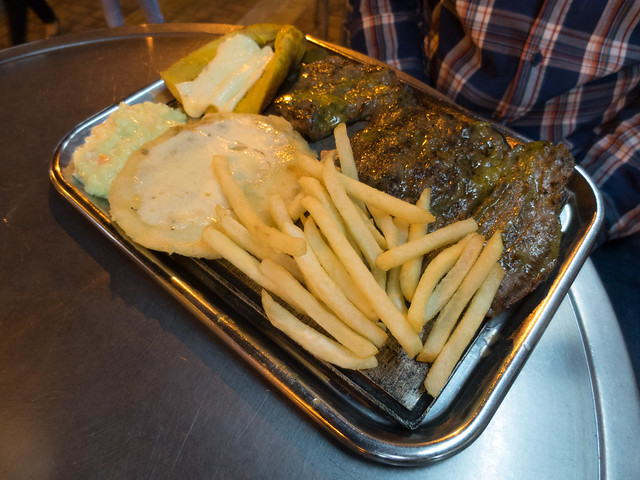
A steady diet of beans, rice, meat, salad, avocado, eggs, arepa and juice might serve you well if you’re a farmer who has to work in the field all day, but who could realistically claim that it’s healthy or appetizing to eat this food every day, with fried cheese sticks, fried pastries, and dried pig skin thrown in for variety?
Nor is it very attractive when one of the many gorgeous women in this city complains about having gastritis.
Locals who claim that they adore arepas will vehemently defend their starchy white hockey puck by saying that it’s amazing after you put butter or salt or cheese on it.
Food that only tastes decent or edible after you smother it with enough toppings to hide the sensation that it tastes like cardboard, is not what I would call good food.
I once had a middle-aged student at an upscale company who had to travel to London for business. He voiced his concerns to me about the food in London.
Aside from London having a large and thriving population of Colombians, the fact that it’s now widely considered to be an international culinary mecca was also lost on my student.
I can’t fathom why he packed four tin cans of Frijoles Antioqueños in his luggage for his week-long trip.
What Day is It?
When telling time here, 12 p.m. is actually midnight, not noon. So if you see that a restaurant is open from 10am until 12 p.m., don’t fret… it’s actually open for 14 hours, not two.
In addition, instead of saying “siete días” for a week, Colombians refer to a week as “ocho días.”
So if it’s Sunday, and your friend says see you in eight days, he doesn’t mean two Mondays, but next Sunday. I can buy, but disagree with, the commonly given explanation that the eight days includes the day that we’re on.
This would then lead one to believe that two weeks should logically be 16 days. It isn’t.
Things get more confusing, with two weeks being “quince (15) días.” It’s completely illogical, and I’ve even seen numerous Colombian children who are learning math ask adults about this.
I once almost had a breakdown in Migración Colombia’s predecessor, el DAS, after I was told that I had “quince días” to apply for a cédula (residence card) after obtaining a work visa.
I went to el DAS exactly 15 days after obtaining the work visa with all the paperwork in order, and was told that I was over the limit by a day. Then the officer and I each counted out our differing versions of 15 days on a calendar to try to prove the other wrong.
I ask, how many days did it take God to create the world? Eight days for Colombians and seven for the rest of us?
Ungodly Hours
Perhaps it’s to make up for the lost productivity (it doesn’t) due to Colombia’s near-record 19 public holidays, but people here work and operate on a schedule that is completely foreign and difficult to swallow for most foreigners.
It’s not uncommon for a paisa to work from 7 a.m. until 5:30 p.m. and then go to an English class from 6:30-8:30 p.m., or continue studying until 10 p.m. in the university. Not even in Bogotá do people enter work so early.
The Metro resembles a sardine can beginning at 5:30 a.m. Many people work or study on Saturdays. A 48-hour work week is the norm, and very frequently people work many more hours, often for very little money.
And Medellín is the only place I’ve ever known in the world that has three rush hours, the third being at lunchtime when most people go home to eat.
When I was first told that I would be teaching English classes at 6 a.m., I thought my boss was joking. Students frequently have to attend class at 6 a.m., which is not productive at all because nearly all of them arrive late or half asleep.
Very few people here can take out loans to pay for university, and so they work full-time while trying to complete their degree, which will take five or six years.
Not one person will tell you that they actually enjoy waking up early, yet everyone does it. This is one of the most visible examples of the industrious reputation that the paisas have. They’re either the most hardworking people I’ve ever met, or the most masochistic.
On the other hand, the city turns into a ghost town on Sundays and public holidays, as everyone who is able flees the city for the countryside, or spends all their time with family.
One would think that with the majority of the people outside of their homes for numerous hours of the day that one could find services that would be amenable for them. But there are few-to-no late night or 24-hour stores or restaurants, and it’s rare to see a restaurant serving breakfast until 8 or 9 in the morning, well after people enter their work.
And try finding a gym that’s open past 3 or 4 p.m. on a weekend, despite the fact that for many people the weekends are the only free time they have.
Despite overcoming huge obstacles and becoming more international, cosmopolitan and open-minded in recent years, Medellín still has one foot in its conservative past. As most locals will tell you, it’s a big town.
Spectacle and Gossip
It’s distressing to see in any big city when people can’t seem to mind their own business. Here it almost seems like an art form.
Many people here either intentionally or subconsciously mettle in the personal affairs of others, and that extends to widespread gossip.
If something out of the ordinary happens, people stop what they’re doing, crowds gather, and everyone gawks as if in a trance with their camera phones pointed in the direction of the disturbance.
If a robbery takes place in the open, locals might immediately chase down the perpetrator, beat and kick him, berate him, film everything with a camera phone, interview the victim, and then post it on YouTube.
A taxi driver decides to circumvent traffic and drives on a sidewalk or pedestrian street, or someone driving down the wrong side of Las Palmas? Likewise filmed and put on YouTube for social denouncement and condemnation.
A couple gets into an argument and one of the two or both will publicly make a scene in a restaurant or on the street, oblivious to the people around them, who will in turn eat it up as if it were a live and free telenovela.
If there’s a traffic accident and someone is seriously hurt most people in the general vicinity will literally stop in their tracks to watch. Is this just to delay having to arrive on time for work?
And if a foreigner happens to have an altercation with a street vendor or decides to stick to their principles and speak out against an injustice, it’s the icing on the cake.
Integration
When it comes to cosmopolitan, Medellín is no New York, Toronto or London. It’s not even close to Bogotá. That being said, it is becoming easier to find foreigners from most corners of the world, and more are choosing to make the City of Eternal Spring their home.
It would logically come as a shock then to discover how difficult it is to “fit in” here, and one has to wonder when the majority of the population will finally get used to there being a lot of foreign residents in their city.
No matter how long you stay and how good your Spanish becomes, there will always be a cashier at the supermarket who refuses to utter a word in Spanish to you and instead simply motions to the price on the register, or an attendant at the bus terminal who slides you a piece of paper for you to write your name on instead of just asking and listening to you.
I have nothing but the utmost respect for locals who don’t stare at or address foreigners as if they were an alien species. Why are we so different anyway?
Colombia itself is one of the most multi-ethnic countries in the world and in fact used to see lots of new arrivals. Now that the security situation has changed and continues to improve, Colombia might be witnessing another extended wave of immigration.
Cognitive Dissonance
Described as a phenomenon in which a person is faced with two opposing internal viewpoints, or a challenge to their strongly held beliefs if you like, this confounding occurrence and not a lack of proficiency in Spanish is often to blame when foreigners find that nobody can understand a word they say.
I once spent five minutes at the checkout counter of a supermarket trying to communicate that I had ordered a sanduche mediterraneo from the deli and that I wanted to pay. Numerous people gathered, including the security guard, trying to understand me to no avail.
Finally I was given a piece of paper and scribbled down the name of my sandwich. A collective sigh indicated that they had all gotten it at once.
I hadn’t been pronouncing mediterráneo correctly. It has an accent mark and the vowel should sound like an “ah” instead of an “eh.”
One would think that an educated individual could figure it out; that they might be able to fill in the gaps if something is not said perfectly. Not here.
Very few locals have ever been exposed to hearing their language spoken a little differently, or a little incorrectly, or even in a different accent.
People I’ve met from Argentina and Spain also report that they’ve come across people who can’t understand a word they’re saying, and it’s the same language… If I can understand what a Chilean wants to communicate even though I don’t recognize all the words, why do so many paisas struggle?
Even if a foreigner has generally mastered Spanish and can communicate fluently, that won’t always save them.
The cashier has been too focused on your light skin, blue eyes, and the fact that you’re a foreigner, and is now too nervous to process information.
You’ve already lost… she’s convinced herself that as a foreigner you won’t be able to say a thing in Spanish, and she’s prepared herself to not understand.
Anything you say at this point in Spanish will go right over her head.
Ask for oregano in Subway and they’ll hear parmesan cheese and put that on your sub instead. Spell out your name J-O-H-N and they’ll listen to you and still write J-H-O-N.
What Did You Say?
During my first six months I was convinced that everyone was calling me a monkey. Everywhere I went people kept addressing me as mono. Then I found out that people intend this word differently, and had basically been addressing me as “blondie.” I think I preferred monkey.
Foreigners should not expect the same kind of political correctness here that they might be used to at home.
People here won’t think twice about calling someone gordo, indio, chino or negro, and nobody bats an eyelash. It’s often meant in good fun or even affectionately. But sometimes things can get ugly or seem downright ignorant.
I have witnessed a friend be branded a racist because he’s a white South African, and another friend called a Nazi and chastised for murdering the Jews simply because he’s German.
I’ve lost track of the number of times I’ve seen Colombians slant their eyes with their fingers when they see or refer to Asians. And if you’re a sensitive, unaggressive and gentle man who treats women well, you must be gay, and the person who informs you of this will mean it as an insult.
Well aware of the ideological problems that some locals have with the United States, I have on occasion just told the taxi driver or new drunk acquaintance that I’m from Canada or New Zealand, in order to avoid what might turn into a diatribe about my country’s policies.
Simply put, many people here have no idea what they’re dealing with when it comes to foreigners because Medellín has only recently started to open up to the world.
The individual that you’ve been talking to might literally have never interacted with a foreigner before. Indeed, anyone with blue eyes is labeled a gringo, asked what things are like “up there,” and assumed to be from “los USA (pronounced oosah).”
Stay tuned for the fourth and final part to this series. Read Part Two here and Part One here.
_________
About the Author: John Knox Seagle is an English teacher and five-year Medellín resident from the United States.