Paisa Customs, Culture Shock
The following is Part One of a four-part series by John Knox Seagle, an English teacher and five-year Medellín resident from the United States.
Foreigners who move to a new country are bound to encounter new customs. In the case of Medellín, they’re paisa customs, and that can lead to a little bit of culture shock.
I’m not saying either side is right or wrong, I’m simply pointing out adjustments that occur (or fail to occur) between paisas and extranjeros.
The purpose of this article is to talk about what things long-term residents of Medellín find frustrating whenever things like this happen to us.
Not every paisa has these traits, but in my experience each of the following things is fairly common.
This article is also not meant to paint Medellín and paisas in a bad light, rather to bring to light some things that some foreigners find they have to get used to make a life here.
In addition, like all foreigners here, I love Medellín, and I could easily write many more words about the things that one can admire and love about this city. But that’s for a different article.
Que Pena
Maybe it’s because the paisas are fiercely proud, or that a reluctance to involve oneself in confrontations in the interest of self-preservation has been ingrained into the local culture, but they’ll often react indignantly or with pure aggression if questioned or told directly that they’ve done something wrong or unacceptable, even if they’re inarguably in the wrong.
A man who I thought was a friend pleaded me for an urgent loan of 200,000 pesos ($106) for an emergency, and promised that he’d pay me back in a month. I wanted to help, and lent him the money. Then he disappeared.
He stopped responding to my messages and deleted me from Facebook. Two years later, after all my attempts to make contact and ask for the money were ignored, I wrote him something that he couldn’t ignore, something I’ll keep between me and him.
Finally, he miraculously appeared, demanding that I show him “respect” while at the same time admitting that he’d literally stolen from me.
Lending money, no matter the culture, can be tricky. Probably best to avoid it here, where immense pride can make things even trickier.
Run For Your Life
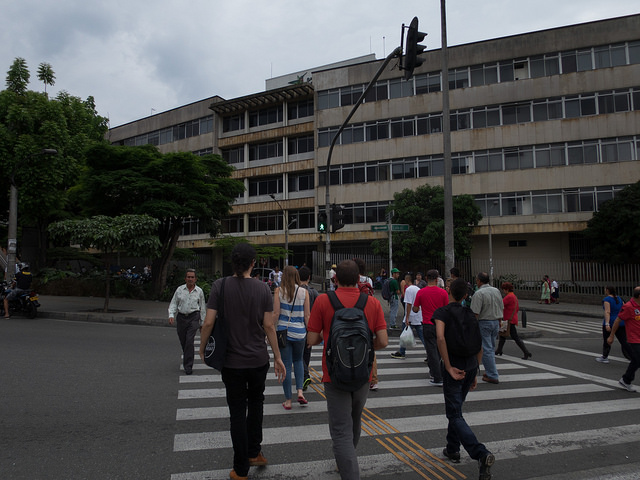
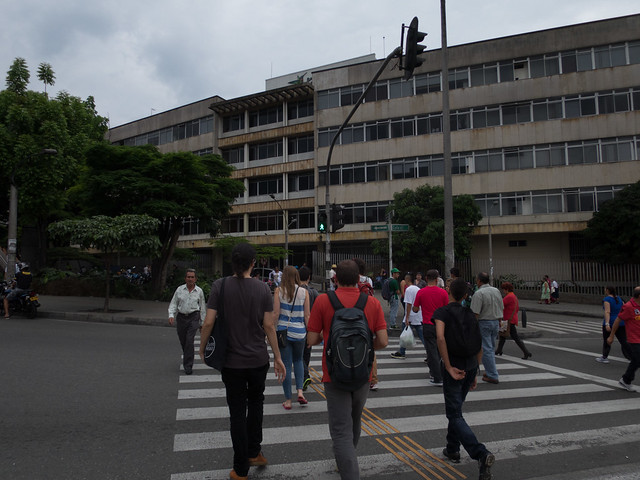
Ask any local and they’ll claim that the crosswalks, or “zebras” are just there for decoration.
The hexagonal red signs that read “PARE” are likewise a mystery for many drivers here, who will advance as far as possible and often stop in the bike lane or crosswalk.
A commonly given explanation for this supposed lack of respect by drivers towards pedestrians or cyclists is that, as cars here are perceived as an indication of an individual having wealth and upper-class standing, some people go on a power trip and feel as if they are “above” everyone else when they are in their car.
After meeting numerous upper-class residents of El Poblado who have literally never taken a public bus or the Metro, I don’t find it hard to believe that some of Medellín’s elite find it difficult to empathize with carless residents.
Car is king in Medellín. Pedestrians beware.
Being “American”
I will happily refer to myself as estadounidense when I’m speaking Spanish. When I’m speaking or teaching English, I am going to say that I am American.
Why?
Because the nationality adjective Unitedstatesian does not exist in the English language. We’re stuck with “American” and I imagine it was devised with the same logic that has led residents of the United States of Mexico to be called Mexicans.
We simply don’t have another word in English to refer to ourselves, and any attempt to link that unfortunate shortcoming of the English language to an assertion that estadounidenses think of themselves as better than everyone else, and for that reason “stole” the word American, is unfortunately very misguided.
North American is incorrect. Canadians will get offended if you call them American. Like I said, it’s a different concept, and nothing to get all worked up about.
Ironically, every time that a Colombian wants to promote whatever they’re selling as “the best” or “high quality,” they won’t hesitate to claim that the tires are “llantas americanas,” and the sellers of treats on the buses always make sure to point out that they’re selling “chocolate americano.”
The logic according to Latinos goes, that since everyone in the Western Hemisphere is living in America, that everyone here is American. With that reasoning I draw two conclusions that have left Colombians baffled:
1. If everyone in the Western Hemisphere, from Canada to Argentina, is technically American, then so are the people in the United States, so it’s technically correct for estadounidenses to refer to themselves as American and nobody has the justification for getting upset.
2. If everyone who lives in America is American, and residents of Colombia are called Colombians in honor of Christopher Columbus, then surely everyone who lives in this hemisphere, which was supposedly “discovered” by Christopher Columbus, should by all rights also be called Colombian.
Nevertheless, according to Latinos, a person in the United States cannot call themselves American, nor are we allowed to call ourselves Colombian because that designation already exists for the people in Colombia.
The point is, we mean no harm or offense when we refer to ourselves as American. In fact, we wish we were given a name more original.
Bicycle lanes are for BIKES
Medellín has a lovely network of bike-only lanes around Laureles/Estadio and Belén that are unfortunately not only for bikes in the minds of many locals.
Why numerous people insist on strolling slowly, walking their dogs or even pushing a baby carriage in these specifically designated lanes is beyond me, but many people simply seem to be oblivious to the fact that there’s always a perfectly good sidewalk adjacent to the bike lanes.
People will likewise step out in front of cyclists, crossing the bike lanes without as much as a glance, as if they were jaywalking.
To make matters worse, most people do not react happily when a cyclist calls out ahead to ask for a “permiso” and try to clear the path. For a country so obsessed with cycling, one would think that urban cyclists would be shown more consideration.
If you’re on your bike, be prepared to stop, sometimes unexpectedly.
I’m Eating!
In many foreign cultures there is nothing cruder or more disrespectful than interrupting someone’s lunch or conversation in order to try to sell them something.
Unfortunately if one chooses to eat on the patio outside a restaurant or on a table next to the sidewalk in Medellín, this is par for the course.
DVDs, USBs, watches, grasshoppers made out of reeds… even fishing poles. Diners are solicited mid-bite or interrupted mid-conversation and are (sometimes aggressively) offered anything imaginable, and it is rare for the restaurant’s employees to come to the rescue and request that their customers be left alone.
Just say, “Gracias,” sometimes several times, and they’ll eventually leave you alone. If that doesn’t work, ask for help from the restaurant staff.
NO
The shoe-shiner points to my work shoes as I walk by, tells me three times that he wants to clean my shoes, I tell him, “Gracias,” I like them dirty like this and that I’m in a hurry.
He calls after me once I’m a half-block ahead, asks me if he can ask me a question, I think why not, a bit of cultural exchange would be nice, and so I walk back to the shoe-shiner, who pauses, smiles, and repeats, “Can I clean your shoes?”
Try to be patient with them. They make only 1,000 pesos ($0.50) per customer.
Stay tuned for Part Two of this four-part series next week.
__________
About the Author: John Knox Seagle, an English teacher and five-year Medellín resident from the United States.