Recently, I was talking to a friend who is fluent in Spanish. She speaks it, she reads it, she’s overall got it down. However, as expected, you can tell she’s foreign when she speaks.
I commented that I thought one of the biggest difficulties for tourists or expats practicing Spanish is the expectation Colombians have when a foreigner approaches them and begins to speak.
Wide-eyed, she told me about how she will constantly talk to someone, and they’ll just close themselves off out of fear of not understanding.
“‘¿Dónde está el baño?’ I’ll ask, loud and clear, and they just stare at me like they have no idea what that means.” She told me, shocked.
Now, this isn’t a bash on Colombians. It happens to everyone. When you’re confronted with the idea of speaking to someone who you assume will speak differently than you, you tend to freeze up. While visiting Canada, every time I was introduced to someone as Colombian, they’d speak to me differently until they realized I speak just like them.
It’s all about expectation, in my opinion. Learning Spanish, I’ve realized recently, and actually using it are almost two different things.
Learning Spanish
There are lots of language schools in Medellín teaching Spanish to visitors of Colombia. Below are just a few we’ve covered here:
They are taking care of the groundwork: teaching vocabulary, tenses, grammar, usage, etc. to people who need these tools to get the ball (or the tongue) rolling.
Some people are even doing it on their own, taking care of Spanish learning the most difficult way: living in the middle of it all until, at some point, it starts making sense.
This is a really exciting part. It may be difficult at first (conjugation is a pain, I know) but this is where the world of Spanish opportunity lays ahead of you like a yellow brick road!
Practicing with Other Students
Any language school knows that it’s vital for students to go through the process with other people that have a similar language level. Slightly higher or lower doesn’t make a big difference because it motivates mutual teaching and progress.
However, if you’re just starting out, and other students in your same class are light-years ahead, it can keep you from trying and being motivated because you figure if that’s the students, what are the locals going to be like?
I know a bit about Spanish schools here, what they teach and how they do it, their philosophies, but I haven’t practiced a new language with locals since I was eight years old. This made me a little inexperienced for this post, so I asked Medellín Living readers and friends.
Practicing With Locals: The Survey
The more curious I got about what it was like to try it out, the more I realized I had to get answers.
I released a survey that would help me understand readers’ perceptions and experiences with Spanish and got some of my friends answer honestly and to help get the word out, like Shaun from Medellin Digital Nomads and Jim from Medellin English-Spanish Events. Thanks, guys!
Here are the results:
Most of those surveyed have practiced Spanish for over a year and live on the West side of Medellín, around Laureles-Estadio, Floresta, Florida Nueva, etc.
When it came to Spanish schools, about half of those surveyed had attended at some point.
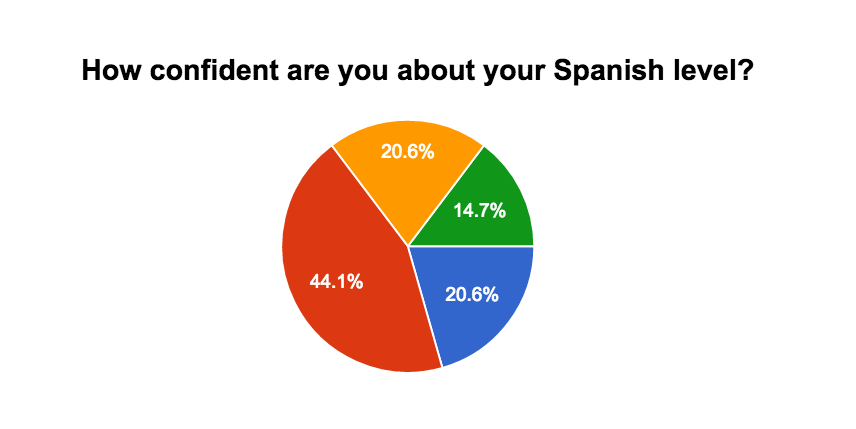
Blue: Not at all; Yellow: Very; Green: Extremely Confident; Red: Somewhat,
Confidence
Very few people surveyed chose the “not at all” option on confidence or the “extremely confident one.
Most of them (about 44 percent) were in a middle gray area where they feel they can defend themselves using Spanish but still fear not understanding.
Spanish Use
Many of those surveyed (about 35 percent) speak less than an hour of Spanish a day!
Which is only partly shocking, because though we are in a Spanish-speaking country, this city accommodates English speakers. We, as Colombians, help those who we see are having difficulties by switching to English sometimes.
About 41 percent of foreigners surveyed speak Spanish between 1-3 hours a day, which is, in my opinion, still hardly an immersion.
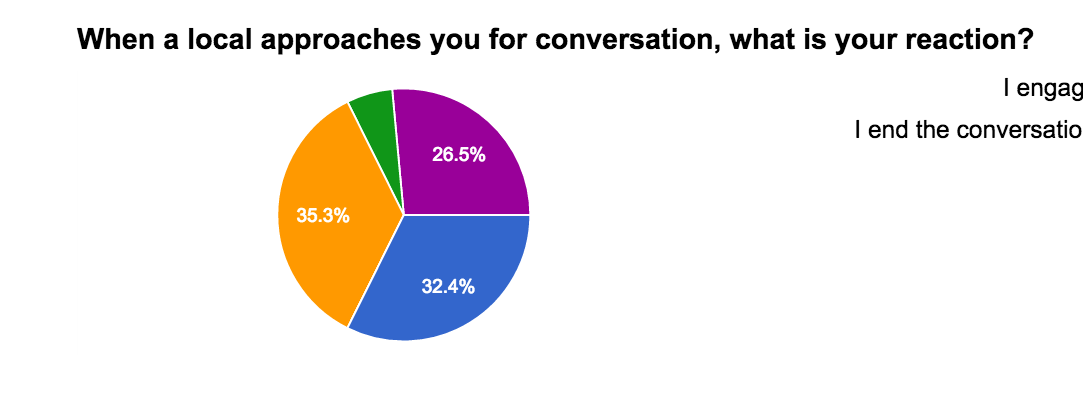
Green: Ask for a translation; Yellow: Get nervous; Blue: engage in conversation; Purple: Other
Attempting Conversation
When approached for conversation, of those surveyed, 35 percent answered they get nervous, and 32 percent engage in conversation. Very few ask for translation, and a couple doesn’t engage at all.
However, the perception of Colombians’ reactions to foreigners practicing Spanish is overwhelmingly positive.
With a couple of “they’ll try to switch to English” answers thrown in and some “they’ll look confused or inconvenienced,” most people noticed Colombians are happy to engage with them in Spanish.
Misunderstandings are a part of language learning! Laugh them off and learn from them.
Difficulties
Most people surveyed answered that their biggest difficulty was understanding three distinct things: accents/speed, slang and nervousness.
I think that the three are closely linked: when approached, Colombian’s won’t usually adjust their speed or accent to help the conversation, just because they don’t know to do that- they haven’t had to before. Therefore, their speed makes their accent tough, and even when they repeat themselves, they don’t slow down.
Slang words will be thrown in because they don’t know what a foreigner does or doesn’t understand, and they use these words daily; it’s part of their regular vocabulary.
Mixing these factors with phone conversations, where you can’t see the person’s lips moving, and you take out body language and gestures, causes panic.
The first few times you try to speak to someone (in person and then over the phone) your sheer nervousness can be one of the main things keeping you from understanding.
Tips for Getting Through it
Again, I am the last person to tell you how to push through language acquisition, so I reached out to some friends of Medellín Living and had some great answers from Luke Tierney at Colombia Immersion.
When I asked him what he thought the most difficult part was about practicing Spanish, his answer corresponded with those of the survey. His Advice?
“Don’t worry, you’ll get it. After that, there are a couple things that stem from typical language learner in a new culture scenarios, but nothing that can’t be surpassed with a little practice.
Depending on what part of town you’re in, locals may have limited or practically no experience with foreigners, so they may be honestly surprised by your accent or little cultural differences (Why are you wearing sandals? Did you just come from a beach?).
You will definitely attract curious looks, but don’t worry, the attention foreigners get here is pretty positive. Colombia’s culture is very friendly and people are happy to help, this is a very supportive place for learning Spanish.”
“Can you speak to me in Spanish?”
I also inquired about what he made of Colombians’ reactions to foreigners attempting Spanish at varied levels. He acknowledged that it’s likely that locals who know English will want to practice with them.”
His thoughts: “Striking up an exchange is easy, though depending on the person you might have to politely remind them to speak to you in Spanish when it’s your turn.”
Getting “good” at Approaching Strangers
“Approaching strangers in a language you don’t yet know is difficult for anyone, but it’s something that you can get good at quickly with a little work. A certain amount of it will always be just taking the leap, but meeting someone who can help you ease into the culture has never been easier.
Language exchanges, couch surfing, and meetups are all easy ways to get to know some native speakers who will be happy to show you the ropes and introduce you to others.
Know that the thing that makes you the most nervous is probably the thing that you need to do the most, and is likely the thing that will result in adventures and surprise friendships. Asking someone to teach you a few salsa moves could lead to a weekend hiking trip with a ton of new people, the possibilities are pretty endless. Make the jump and people will catch you.” said Tierney.
“The most important thing to realize is that those moments you don’t understand are actually the moments you really want to invest in”
When You Simply Can’t Understand
It’s not comfortable to have someone talk to you and not understand.
Similar to when you’re at a club, and the music is blasting, your dance partner has repeated the same thing to you four times, and the fifth you just pretend you understood.
At some point, you think “Should I just move on even though I have no idea what he/she said?”
Short answer?
No.
“This is guaranteed to happen quite a bit at various stages, and that’s ok. It’s part of the process. Letting people know from the get-go that you are learning can help calm your own nerves by removing performance pressure.
You can let them know you didn’t understand. They’ll want to help you get it. The most important thing to realize is that those moments you don’t understand are actually the moments you really want to invest in.
It may not feel like it, but anytime you’re listening hard and only getting a certain amount, you’re actually learning. Language is not just something you can read and then apply, it’s something you have to get in your ear, practice, mess up, try again, and keep going.
Embrace the beginner’s mindset. After several of those ‘clueless’ moments, you’ll actually begin to realize oh my god, I actually know those words. Things will begin to click, and your confidence will grow.”
My Thoughts
So, after this long endeavor (seriously, this has kept me up at night), I still have questions I’d like to answer in the future.
How many expats want to learn and practice Spanish?
Does the fact that the majority of expats are living in English-speaking hot-spots in the city affect the amount of time that expats practice Spanish?
How can those who want to use Spanish everyday push themselves to do it, even in areas that prove difficult?
We’ll have to come back with those later in the year. In the meantime, give me your opinion.
What helps you practice Spanish in Medellín? Let us know in the comments below!
TLDR? The El Celestino Spa offers one of the best massages in Medellin. Routine makes us forget the good things we deserve. One of them is pampering ourselves. Massages are one of the ways that I personally love to…